.svg)
The Ultimate Guide to AI Models & APIs for Vibe-Coded Products
Choosing the right AI model for your project feels a lot like casting the lead actor in a movie. It’s not just about who can deliver the lines; it’s about who has the right vibe. One model might give you a sharp, analytical performance, while another offers creative, poetic flair. Pick the wrong one, and the entire production feels off.
You're here because you're past the "what is an AI API?" stage. You're deep in the evaluation process, weighing options from OpenAI, Anthropic, and Google. You've probably seen a dozen listicles and pricing pages that all say the same thing. But they miss the most important question: which model will match the unique soul of your product?
This is where most guides fail. They give you spec sheets, but you need a director's notes. They compare pricing but don't analyze performance-per-dollar for creative tasks. They leave you to piece together tutorials, troubleshooting forums, and security best practices.
We’re changing that. This is your one-stop resource for moving from comparison to confident integration. We'll break down the Big Three not just on speed and cost, but on personality and creative style. We'll give you actionable code and the security checklists other guides forget.
Let's find the perfect AI co-pilot for your build.
The Big Three Showdown: OpenAI vs. Anthropic vs. Google
The current landscape is dominated by three major players. While they all offer powerful large language models (LLMs), their outputs, performance, and cost structures have critical differences that directly impact your final product.
The Vibe Check: Matching the Model to Your Creative Vision
A model's "vibe" is its personality—the subtle character that shines through in its responses. Is it a precise academic, a whimsical storyteller, or a helpful assistant? To illustrate, we gave the same prompt to the flagship models from each provider.
Prompt: "Write a short, evocative description for a new app called 'ChronoWeaver' that lets users send messages to their future selves."
OpenAI's GPT-4o:
"Capture today's moments for tomorrow's memories. With ChronoWeaver, send letters through time to the person you'll become. Seal your thoughts, dreams, and warnings, and let your future self unravel the wisdom of the past." Vibe: Polished, professional, and highly effective. It sounds like perfect marketing copy—clear, benefit-driven, and a little poetic. It’s the reliable A-student who always delivers quality work.
Anthropic's Claude 3 Opus:
"We are all storytellers, and our greatest audience is the person we have yet to meet: our future self. ChronoWeaver is a loom for your timeline. Weave threads of thought, hope, and reflection into a tapestry of time, to be unspooled when you need it most." Vibe: Thoughtful, literary, and slightly philosophical. It uses more metaphors and feels more human-written. Claude often leans toward a more verbose and descriptive style, making it excellent for storytelling applications like [] OnceUponATime Stories.Google's Gemini 1.5 Pro:
"Talk to your future. ChronoWeaver is your personal time capsule. Record a video message, write a quick note, or save a photo today and schedule its delivery for a month, a year, or a decade from now. What will you tell yourself?" Vibe: Pragmatic, direct, and feature-focused. It immediately grounds the concept in practical use cases (video, note, photo). Gemini excels at being a helpful, functional tool that gets straight to the point.
This simple test reveals a crucial insight: the "best" model depends entirely on the experience you want to create.
Performance Benchmarks: Speed vs. Throughput
Slow API responses can kill your product's vibe instantly. But performance isn't just about raw speed. We need to look at two key metrics:
- Latency (Time to First Token): How quickly does the user start seeing a response? This is critical for conversational, real-time applications.
- Throughput (Tokens per Second): How fast does the full response generate after it begins? This matters more for long-form content generation.
To cut through the noise, we ran our own tests on a standard 500-word summarization task.
Note: These are our internal benchmarks and can vary based on server load and query complexity. However, they reflect the general performance characteristics of each model.
As the data shows, if your app relies on snappy, chat-like interactions, GPT-4o's low latency is a major advantage. If you're building a tool to analyze large reports, Gemini's throughput is hard to beat.
The key takeaway? Don't just choose the cheapest model. Consider the total cost of getting the result you need.
Beyond Text: Integrating Image, Audio, and Video
A modern vibe-coded product often speaks in more than just words. From animating old photos with tools like [] Timeless Memories to creating beats with Mighty Drums, multi-modal AI is essential.
- For Image Generation: Stability AI and Midjourney are leaders in creative quality, while OpenAI's DALL·E 3 offers fantastic API integration and prompt adherence.
- For Audio & Voice: ElevenLabs is the gold standard for realistic text-to-speech and voice cloning. For audio processing and conversion, you might find specific libraries or tools like []
Audio Convertmore suitable. - For Video: Services like Runway and Pika are pushing the boundaries of text-to-video, but API access can still be limited. Keep an eye on this rapidly evolving space.
The strategy here is to use a primary LLM for logic and text, then call specialized APIs for specific multi-modal tasks.
Your Actionable Integration Guide
Moving from decision to implementation should be painless. Here are the essentials to get you started securely and efficiently.
Quick-Start Code Snippets
Here’s how to make your first API call to OpenAI using Python and Node.js. The structure is very similar for Anthropic and Google.
Python (using openai library):
import os
from openai import OpenAI

# Best practice: use environment variables for your API key
client = OpenAI(api_key=os.environ.get("OPENAI_API_KEY"))

completion = client.chat.completions.create(
  model="gpt-4o",
  messages=[
    {"role": "system", "content": "You are a helpful assistant."},
    {"role": "user", "content": "Hello! What is vibe coding?"}
  ]
)

print(completion.choices[0].message.content)
Node.js (using openai library):
import OpenAI from 'openai';

// Best practice: use environment variables for your API key
const openai = new OpenAI({
  apiKey: process.env.OPENAI_API_KEY,
});

async function main() {
  const completion = await openai.chat.completions.create({
    messages: [{ role: 'system', content: 'You are a helpful assistant.' }, { role: 'user', content: 'Hello! What is vibe coding?' }],
    model: 'gpt-4o',
  });

  console.log(completion.choices[0].message.content);
}

main();
The Missing Manual: API Key Management Best Practices
This is the section most guides skip, and it's one of the most critical. Mishandling your API keys can lead to security breaches and runaway costs.
- Never Hardcode Keys: Never paste your API key directly into your code. If you commit it to a public repository like GitHub, bots will find and abuse it within seconds.
- Use Environment Variables: As shown in the code snippets, store your keys in environment variables (
.envfile locally, or secrets management in your hosting provider like Vercel or Netlify). This keeps them separate from your codebase. - Create Specific Keys for Specific Projects: Don't use a single master key for everything. Generate unique keys for each application so you can monitor usage and revoke access for a single project if it's compromised.
- Set Up Billing Alerts: All major providers allow you to set billing limits and alerts. Set a soft limit to get notified and a hard limit to prevent your bill from spiraling out of control if a key is leaked or your app gets unexpected traffic.
Troubleshooting: Why Is My API Call So Slow?
You’ve integrated the API, but the user experience is sluggish. This is a common complaint seen across developer forums. Before blaming the provider, run through this checklist:
- Are You Streaming? For real-time applications, always use streaming responses. This sends tokens back as they're generated, dramatically improving perceived performance.
- Which Model Are You Using? Are you using a flagship model like GPT-4o for a task a smaller, faster model could handle? Test different tiers.
- What's Your Payload Size? Sending a massive prompt with thousands of tokens of history will naturally take longer to process. Trim your context where possible.
- Where Is Your Server Located? If your server is in Europe and the API provider's servers are in the US, network latency can add hundreds of milliseconds to every call. Co-locate your servers if possible.
Our Recommendation: Picking the Right Model for the Vibe
- For Creative Storytelling & Polished Copy: OpenAI's GPT-4o or Anthropic's Claude 3 Opus. They excel at nuance, creativity, and generating human-like text. Perfect for apps like
OnceUponATime Storiesor an AI writing assistant likeWrite Away. - For Reliable, Tool-Like Functionality: Google's Gemini 1.5 Pro. Its speed, massive context window, and direct, factual nature make it ideal for data extraction, summarization, and function-calling.
- For the Best Bang-for-Your-Buck: Anthropic's Claude 3 Sonnet. It hits the sweet spot between cost, speed, and quality, making it a fantastic and reliable default choice for a wide range of applications.
Frequently Asked Questions
Q: Can I get started with these APIs for free?A: Yes, most providers offer a free tier or initial credits so you can experiment without commitment. OpenAI, for example, typically provides new accounts with free credits, and Google's Gemini API has a generous free tier for lower-traffic applications. Always check the latest pricing pages for details.
Q: What are the main differences in API data privacy policies?A: This is a critical consideration. OpenAI and Google have policies stating they will not use API-submitted data to train their models. Anthropic has a similar commitment. However, you should always review the most current terms of service, especially if you are handling sensitive user data.
Q: How do I handle rate limits?A: Rate limits prevent abuse and ensure service stability. To manage them, you should implement exponential backoff logic in your code. This means if a request fails due to a rate limit, your code waits for a progressively longer period before retrying.
Q: Is it better to use the provider's official SDK or just make direct HTTP requests?A: For almost all use cases, using the official SDK (like the openai Python or Node.js library) is highly recommended. SDKs handle authentication, request formatting, and complex features like streaming for you, which saves significant development time and reduces potential errors.
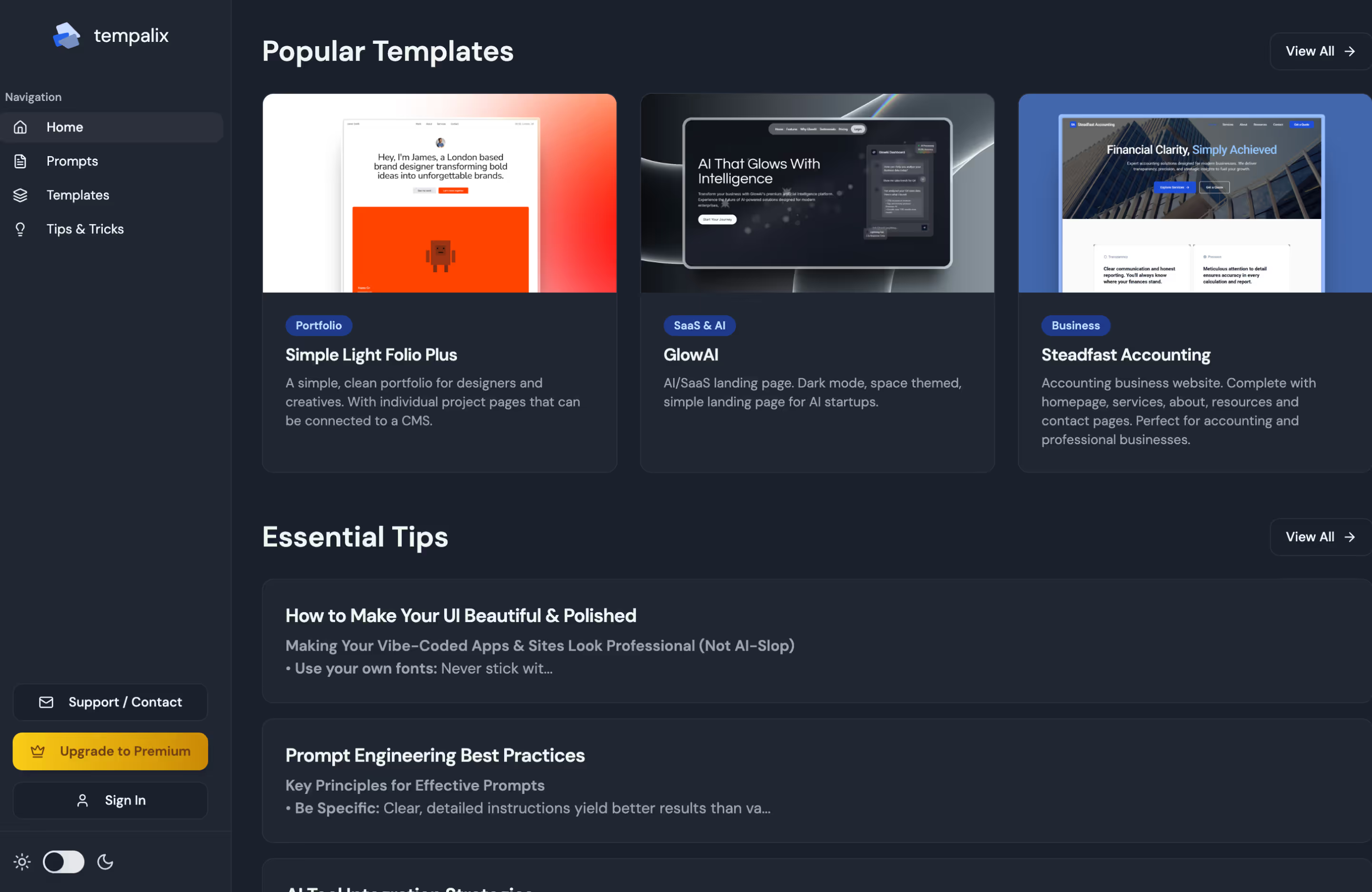
Your journey into building with AI is just beginning. By choosing a model that aligns with your product's core vibe, you're not just integrating a feature—you're creating a more compelling and resonant experience. Explore the [] projects on Vibe Coding Inspiration to see how other developers are bringing their ideas to life, and start building something amazing.