.svg)
Beyond Speed: Why Thoughtful Friction is the Future of AI Design
Ever found yourself in a loop with an AI tool? You fire off a prompt, get a result, tweak it, fire again. And again. After thirty minutes, you have dozens of variations but feel more like a machine operator than a creative partner. You’ve been moving fast, but not necessarily getting anywhere meaningful.
This is the "Speed Trap" of modern AI. We've become obsessed with making AI interactions seamless, instant, and frictionless. But in our race for efficiency, we risk designing tools that encourage shallow engagement and mindless output.
What if we took a different approach? What if, instead of only optimizing for speed, we designed AI to make us pause, reflect, and think more deeply? This is the power of Intentional Friction—a design philosophy that's not about slowing users down, but about helping them engage more mindfully.
Friction as a Feature, Not a Flaw
When designers hear the word "friction," they usually think of a problem to be solved. It’s the unnecessary step, the confusing layout, the button that’s hard to find—all the things that create a bad user experience.
But that’s unintentional friction.
Intentional Friction is different. It’s a deliberate, carefully placed design choice that creates a moment of resistance to improve the overall user experience. Think of the classic “Are you sure you want to delete this file?” dialogue box. That simple step—that moment of friction—prevents countless errors by forcing a moment of consideration.
In the world of AI, this concept is even more critical. When an AI can generate an essay or an image in seconds, the cost of creation becomes nearly zero. Intentional friction reintroduces a sense of value and deliberation, transforming the user from a passive consumer into an active collaborator.
Key Takeaway
Intentional Friction isn’t bad UX. It’s a strategic tool used to guide user behavior, prevent errors, and encourage more thoughtful interaction.
Finding Your Place: The Mindful Interaction Spectrum
Not every AI tool needs the same amount of friction. An AI that analyzes massive datasets for a scientist should be lightning-fast. But an AI journaling partner that helps a user explore their feelings should probably encourage a slower, more reflective pace.
To help designers figure this out, we can use The Mindful Interaction Spectrum. This framework helps you identify the primary goal of your AI tool and decide where it should live between two poles:
- Efficiency-Focused: These tools are built for speed and accuracy. The goal is to remove cognitive load and deliver answers as quickly as possible. Think data analysis, code completion, or file conversion tools.
- Mindfulness-Focused: These tools are built for depth and creativity. The goal is to increase cognitive engagement and facilitate a thoughtful process. Think AI creative writing partners, music composition tools, or personal reflection apps.
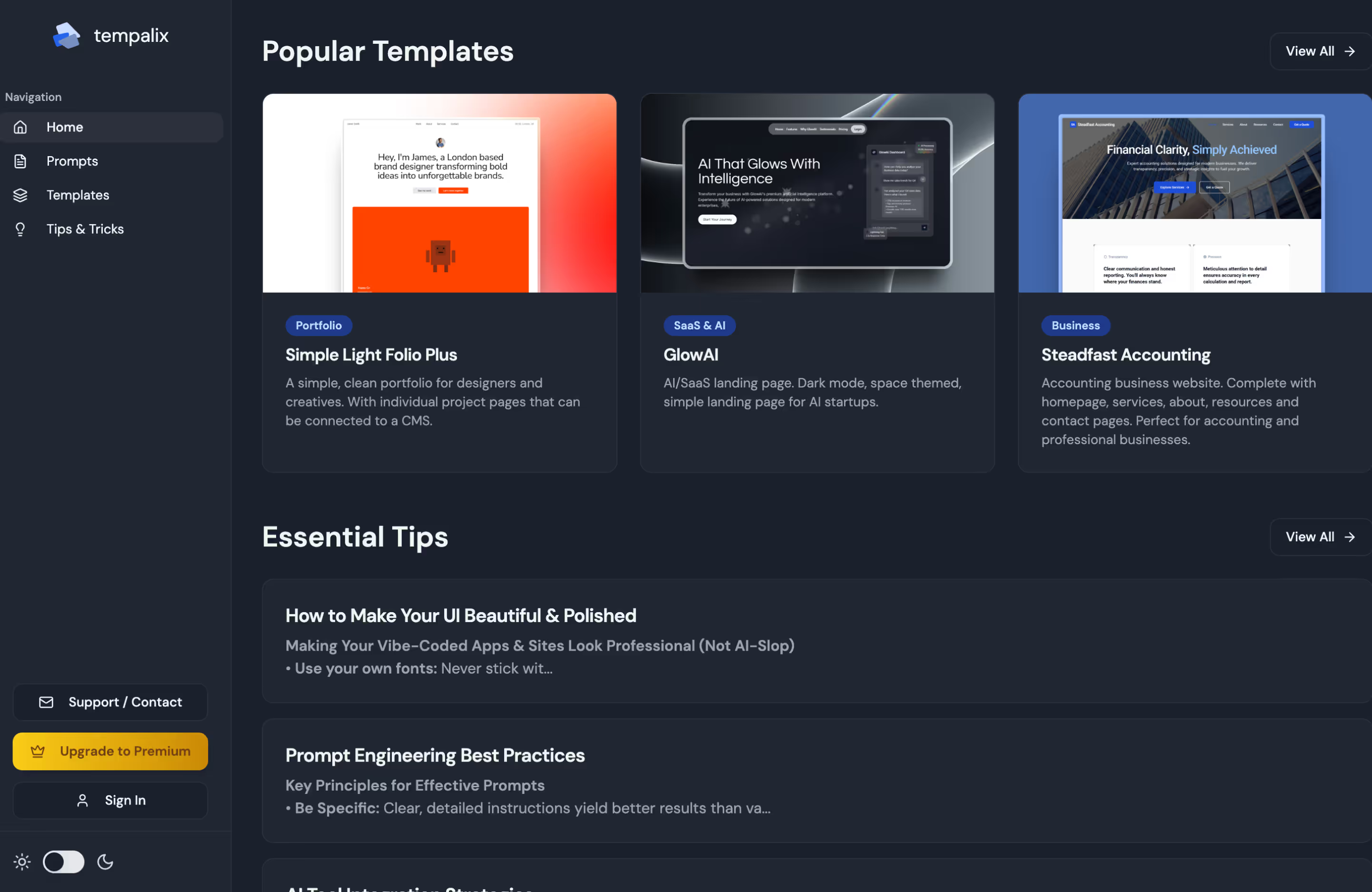
This is the essence of creating "Vibe-Coded Tools." These are applications where the user experience is intentionally crafted to evoke a specific feeling or "vibe"—be it creative, reflective, playful, or focused. Friction is the primary mechanism you use to achieve that vibe. By understanding where your product fits on the spectrum, you can begin to make conscious design choices that serve your user's deeper needs. It’s a chance to explore a universe of possibilities and that are already pioneering this new frontier.
A Pattern Library for Mindful AI Interaction
So, how do you actually build intentional friction into an AI interface? It's not about adding random loading spinners. It's about implementing specific UI patterns that encourage a different kind of interaction.
Here are four common patterns for designing mindful friction into your AI tools:
1. The Reflective Pause
This is a mandatory, but brief, waiting period before an AI generates a response. Instead of an instant answer, the interface might show a thoughtful animation or a message like, "Thinking…" or "Composing a thoughtful response…"
- Why it works: It breaks the instant gratification loop. This small delay gives the user a moment to re-read their prompt, consider its implications, or simply take a breath. It frames the AI's output as a considered piece of work, not just a cheap commodity.
2. The Considered Input
Instead of a single, open-ended prompt box, this pattern uses a more structured interface to guide the user's input. This could be a multi-field form, a canvas with different sections to fill out, or a series of guided questions.
- Why it works: It forces the user to deconstruct their thoughts. A tool like
OnceUponATime Storiesmight ask for a character, a setting, and a moral before writing a story. This friction encourages better, more structured inputs, which leads to higher-quality AI outputs.
3. The Human Handoff
This pattern involves the AI completing a small portion of a task before intentionally "handing off" control back to the user for review, editing, and approval. An AI writing assistant might draft a single paragraph and then stop, waiting for the user to make edits before proceeding.
- Why it works: It keeps the human in the driver's seat. This prevents the user from passively accepting whatever the AI generates. By breaking the task into smaller, collaborative chunks, it fosters a partnership where the AI assists rather than replaces the user's judgment.
4. The Effortful Interface
This pattern replaces simple, efficient controls (like a text box) with more tactile, deliberate ones (like sliders, dials, or even drag-and-drop elements). For example, an AI music generation tool might ask the user to adjust sliders for "Tempo," "Mood," and "Complexity" instead of just typing "fast, happy, simple song."
- Why it works: It makes the interaction more physical and intentional. The act of manipulating a control requires more focus than typing, connecting the user more deeply to the creative choices they are making.
Is Your AI Encouraging Mindfulness or Mindlessness?
Ready to apply these ideas? Take a moment to audit your own AI project or a tool you frequently use. Ask yourself these questions:
- What is the core purpose of this tool? Is it meant for pure efficiency, or is there a creative or reflective component? Where does it fall on the Mindful Interaction Spectrum?
- Where do users move too fast? Identify moments in the user journey where a lack of friction might lead to sloppy inputs or uninspired outputs.
- Could a pause create value? Would a moment of forced reflection before generation improve the user's final result or their feeling of ownership over it?
- How can I make the input more deliberate? Can I transform a simple text box into a more structured or effortful interface to guide the user toward better prompts?
Starting with these questions can reveal surprising opportunities to deepen user engagement and create a more valuable, memorable experience.
Frequently Asked Questions
But isn't friction just bad UX?
This is the most common misconception. Unintentional friction (like a slow-loading page or a confusing menu) is always bad. Intentional friction is a strategic choice that adds value—it prevents errors, increases security, or, in this case, fosters a more mindful interaction that leads to a better outcome for the user.
How much friction is too much?
It all depends on the context defined by the Mindful Interaction Spectrum. A little friction can be powerful, but too much will feel like a chore and drive users away. The key is to add just enough resistance to make the user pause and think, without making the tool frustrating to use. Always test with real users to find the right balance.
Does this apply to every AI tool?
No, and it shouldn't. For tools where speed and efficiency are the primary goals (like an AI-powered calculator or data processing tool), adding friction would be counterproductive. Intentional friction is best suited for creative, educational, or reflective AI applications where the process is just as important as the outcome.
How do you measure the "success" of friction?
Instead of traditional metrics like "time on task" or "conversion rate," you'd look for signs of deeper engagement. This might include higher-quality outputs (as judged by the user), increased user satisfaction, or qualitative feedback showing that users feel more creative, in control, and proud of the work they produce with the AI.
From Mindless Speed to Mindful Collaboration
The next wave of innovation in AI won't just be about making models faster or more powerful. It will be about designing interactions that elevate human creativity and thoughtfulness. By moving beyond the obsession with frictionless design, we can create vibe-coded tools that serve as true partners in our work and lives.
If you're ready to see what this new wave of design looks like, a great next step is to find that are already putting these principles into practice. By learning from them, you can start building AI tools that don't just provide answers, but help us ask better questions.