.svg)
From 'Aesthetic' to Algorithm: A Practical Guide to Vibe-Driven AI Design
Ever tried to explain a feeling to a machine? You've likely found yourself in a product meeting describing the AI you want to build. "It should feel… welcoming," you say, or "the vibe needs to be more playful and curious." Your design team nods enthusiastically, while your engineering team exchanges glances that say, "What does 'playful' mean in Python?"
This is the billion-dollar translation problem at the heart of modern product development. Companies like Duolingo have built empires on the distinct "vibe" of their AI characters—in their case, a motivating but slightly unhinged owl. Get the vibe right, and you create a memorable, engaging experience. Get it wrong, and you build something that feels generic, jarring, or just plain off.
The challenge is that the internet is split into two disconnected worlds. On one side, UX blogs and design forums talk poetically about "AI personality" and the "age of vibes." On the other, technical guides explain the mechanics of "vibe coding" as an AI-assisted development practice. There has been no bridge between the why—the aesthetic vision—and the how—the data, the algorithms, and the feature specs.
Until now. This guide provides a structured methodology to translate those intangible, aesthetic concepts into concrete, quantifiable engineering tasks. It’s time to stop talking past each other and start building AI with intentional, measurable personality.
The Great Divide: Why Your AI's 'Vibe' Feels Off
If you've ever felt like your product's AI doesn't match your vision, you're not alone. The gap between a design brief and the final product is a common source of frustration, leading to wasted development cycles and user experiences that fall flat.
This disconnect happens because designers and engineers are often working with different toolkits and vocabularies.
- Designers think in terms of user experience: They use mood boards, user personas, and descriptive words like "serene," "authoritative," or "whimsical" to define the desired emotional impact.
- Engineers think in terms of system behavior: They work with parameters, datasets, response latencies, and API calls to define the AI's functionality.
Without a shared language, "make it more friendly" becomes a guessing game. Does "friendly" mean using more emojis? Responding faster? Using simpler language? Each of these has different technical implications. The current educational landscape reflects this fragmentation. You can find high-level inspiration on UX Collective or dive into technical, platform-specific guides on Reddit, but the piece that systematically connects them is missing.
This guide provides that connection. We'll introduce a framework that turns abstract feelings into a technical spec sheet anyone can build from.
[]
Deconstructing the Intangible: What Is an AI Vibe, Really?
First, let's demystify the concept. An AI "vibe" isn't some magical, emergent quality. It's the tangible result of a series of deliberate technical choices.
In an engineering context, an AI vibe is a consistent and predictable set of behavioral biases and data interaction patterns that collectively create a desired user perception.
Instead of thinking of a vibe as a single, fuzzy goal, we can break it down into core, measurable components:
- Tone: The vocabulary, formality, and emotional valence of the language used. Is it formal or casual? Enthusiastic or reserved?
- Pace: The speed and rhythm of interaction. Does it respond instantly or with a thoughtful pause? Are its messages short and quick or long and detailed?
- Knowledge Depth: The AI's area of expertise and how it presents information. Is it a generalist or a deep specialist? Does it cite sources or speak from apparent authority?
- Risk-Aversion: Its willingness to speculate, make jokes, or operate in ambiguous situations. Is it strictly cautious or creatively adventurous?
- Emotional Range: The spectrum of emotions it can simulate or respond to. Can it detect user frustration and adapt its approach?
By defining our desired vibe across these components, we move from a vague feeling to a set of specific characteristics we can start to measure and build.
The Vibe-to-Spec Framework™: Your Bridge from Concept to Code
This is the core of our methodology: a four-step process for turning a vibe into a technical blueprint. This framework ensures that your design vision is translated accurately, giving your engineering team the clarity they need to build the right experience.
Step 1: Build Your Vibe Lexicon
Before you can quantify a vibe, you have to define it with precision. A single word like "serene" is too ambiguous. This step is about building a rich, shared vocabulary.
- Brainstorm Keywords: Start with your core vibe word ("serene") and expand it. What are its synonyms? (Calm, tranquil, peaceful, gentle).
- Define Anti-Goals: What is the vibe not? An anti-goal for "serene" might be "anxious," "rushed," "hyper," or "salesy." This is often more clarifying than the positive keywords.
- Create a Mood Board: Collect images, color palettes, and snippets of text that embody the feeling. This visual reference is invaluable for keeping everyone aligned.
Your output from this step is a simple document that clearly defines the target aesthetic, providing a guiding star for the entire team.
Step 2: Attribute Mapping: From Words to Metrics
This is where the magic happens. We connect the descriptive words from our lexicon to measurable technical attributes. This is the most crucial step for bridging the design-dev divide.
Let’s see how this works with two different vibes:
For a 'Serene' Vibe:
- Keyword: "Gentle" -> Attribute: Low information density. Metric: Responses average 2-3 short sentences.
- Keyword: "Calm" -> Attribute: Slow pace. Metric: Introduce an artificial response delay of 1.5-2.5 seconds.
- Keyword: "Peaceful" -> Attribute: Positive/neutral sentiment. Metric: Target a sentiment analysis score of +0.1 to +0.4; avoid words from a pre-defined high-arousal lexicon (e.g., "urgent," "critical," "failure").
For a 'Playful' Vibe:
- Keyword: "Spontaneous" -> Attribute: High novelty. Metric: Set model "temperature" (randomness) to 0.8; include a feature that suggests unexpected ideas.
- Keyword: "Energetic" -> Attribute: Fast pace. Metric: Response latency under 500ms; average sentence length of <10 words.
- Keyword: "Humorous" -> Attribute: Use of levity. Metric: Set probability of using an emoji or GIF in response to 15%; fine-tune the model on a dataset known for wordplay.
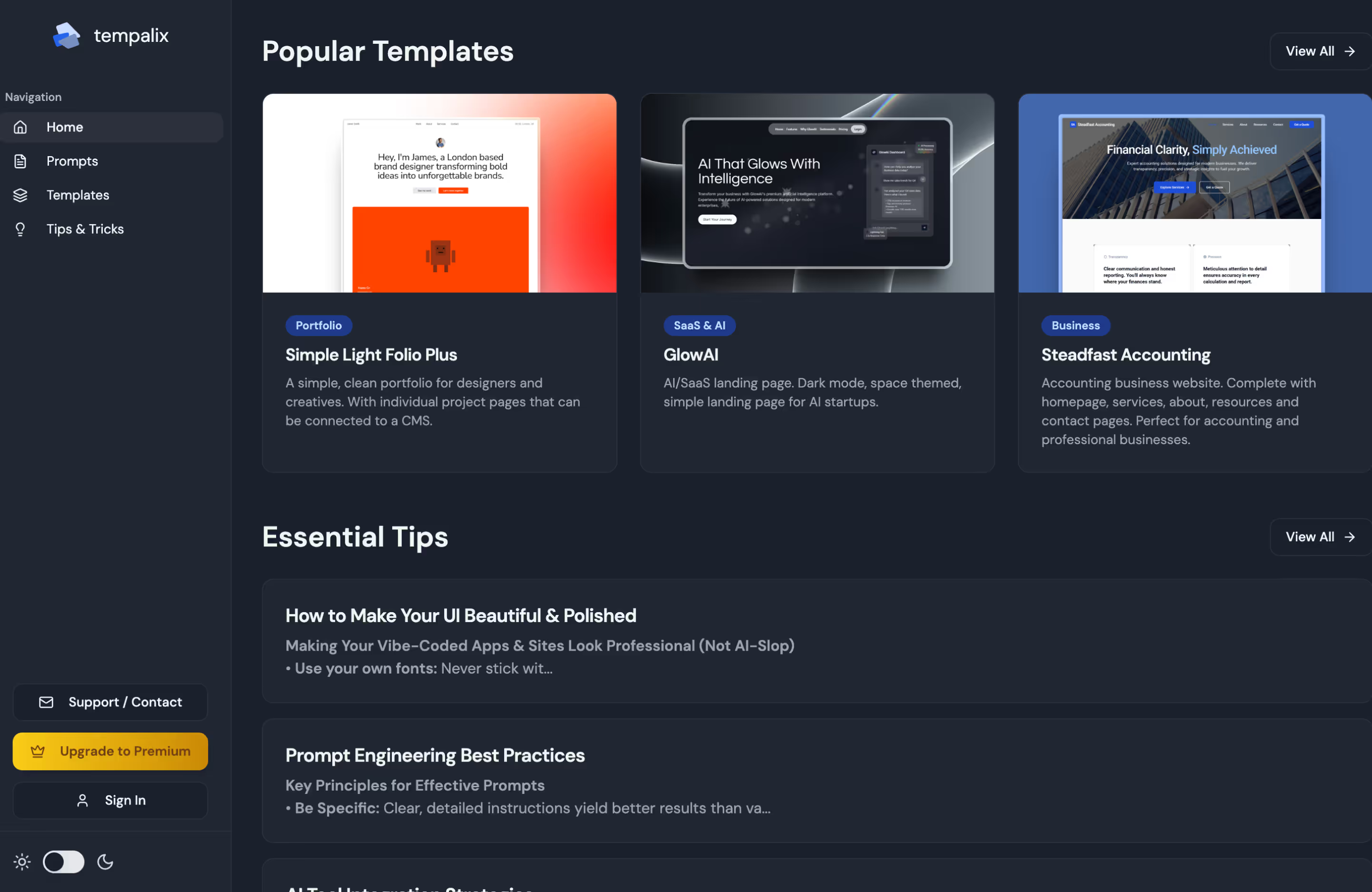
Exploring a gallery of diverse [] can help you see how different attribute mappings result in unique user experiences.
[]
Step 3: Specify Your Data and Models
Your mapped attributes now dictate your technical needs. A "trustworthy financial vibe" and a "whimsical storytelling vibe" cannot be built with the same raw materials.
- Data Requirements: Does your vibe require a specialized dataset? The financial AI needs data rigorously scrubbed of misinformation. The storytelling AI would benefit from being fine-tuned on a corpus of fantasy novels and poetry.
- Model Selection: Is a massive, general-purpose LLM necessary, or can a smaller, fine-tuned model deliver the vibe more efficiently and safely? A highly constrained, "professional" vibe might even be better served by a simpler, rule-based system.
- Safety Guardrails: How does your vibe affect safety? A "playful" AI needs guardrails to ensure its jokes don't cross lines. An "authoritative" AI needs strict constraints to prevent it from giving dangerous advice.
Step 4: Draft the Vibe Spec Sheet
The final output of this framework is a single source of truth: The Vibe Spec Sheet. This document contains the Vibe Lexicon, the Attribute Mappings, and the Data/Model Specifications. It's not a design brief; it's a technical blueprint.
When a designer hands this sheet to an engineer, the conversation changes. "Make it feel more serene" becomes "Implement a 2-second response delay, filter for high-arousal words, and cap message length at three sentences." This sheet becomes the blueprint for all your [] from that point forward.
Putting It Into Practice: Vibe-to-Spec Case Studies
Let's walk through two examples to see how the framework applies in the real world.
Case Study 1: The "Authoritative & Trustworthy" Financial Advisor AI
- Vibe Lexicon: Keywords: reliable, clear, precise, formal, secure. Anti-goals: casual, speculative, emotional, salesy.
- Attribute Mapping:
- Clarity: Target a Flesch-Kincaid readability score of grade 10-12.
- Precision: Model temperature set to 0.1 to reduce hallucinations. Must cite sources for all statistics.
- Formality: Prohibit use of emojis, slang, and contractions.
- Spec Sheet Highlights: Requires a dataset of vetted financial documents. Implements strict guardrails to prevent giving personalized financial advice, instead phrasing responses as "educational information."
Case Study 2: The "Whimsical & Creative" Idea Generation AI
- Vibe Lexicon: Keywords: imaginative, surprising, playful, magical. Anti-goals: literal, boring, repetitive, critical.
- Attribute Mapping:
- Imagination: Model temperature set to 0.9 to encourage novelty.
- Surprise: High probability of using metaphors and analogies in responses.
- Playfulness: Varied sentence structure and a 10% chance to respond with a question instead of a statement.
- Spec Sheet Highlights: Fine-tuned on a corpus of science fiction, fantasy, and poetry. Looser guardrails on "factual accuracy" to prioritize creative output over literal truth.
[]
Common Pitfalls and Advanced Considerations
As you implement this framework, be aware of common challenges:
- Pitfall: The Overly Friendly Vibe. A "friendly and empathetic" vibe might seem universally positive, but it can backfire spectacularly. In a crisis response scenario (e.g., a security alert system), an overly casual or emotional tone can undermine the urgency and authority of the message, causing users to dismiss a critical warning.
- Measuring Success: How do you know if your vibe is working? This goes beyond standard performance metrics. You'll need to use user surveys ("On a scale of 1-5, how 'creative' did you find the AI's suggestions?"), A/B testing different attribute settings, and monitoring user retention.
- Managing Trade-offs: Often, vibe attributes are in conflict. Increasing "spontaneity" (higher temperature) can decrease "reliability" (factual accuracy). Making an AI more "thorough" (longer responses) can make it feel less "energetic." Your Vibe Spec Sheet should acknowledge these trade-offs and define the right balance for your specific use case.
Frequently Asked Questions (FAQ)
[]
What is vibe-based AI design?
Vibe-based AI design is an approach to product development that prioritizes the overall feeling, personality, and emotional resonance of an AI system as a core feature. Instead of starting with just functions, it starts with defining the desired user experience and perception—the "vibe"—and uses that to guide technical development.
How is 'vibe design' different from 'vibe coding'?
'Vibe design' refers to the strategic and creative process of defining the AI's personality and interaction style (Steps 1 & 2 of our framework). 'Vibe coding' is a more recent term often used to describe the practice of using an AI assistant to help write code based on high-level, descriptive prompts. Our framework connects the two: you use vibe design to create a clear spec, which can then guide the vibe coding process more effectively.
Can you really quantify a subjective experience like a 'vibe'?
Absolutely. While the feeling itself is subjective, the behaviors that cause that feeling are not. We can't directly measure "serenity," but we can measure response latency, sentence length, and vocabulary choice. By systematically controlling these measurable inputs, we can reliably produce the desired subjective output.
Why is defining an AI's vibe so important?
In a world where the underlying AI models are becoming commoditized, user experience is the key differentiator. A well-defined vibe makes a product more memorable, engaging, and trustworthy. It turns a functional tool into a beloved product, creating a moat that competitors can't easily cross just by using the same API.
Your Journey into Vibe-Driven Development
Translating an abstract "vibe" into a functional algorithm isn't an act of magic; it's an act of methodical, intentional design and engineering. By treating your AI's personality as a core feature and using a structured process like the Vibe-to-Spec Framework™, you can eliminate ambiguity, align your teams, and build products that feel exactly how you imagined them.
This is the future of human-AI interaction—not just building tools that work, but creating collaborators that we understand and enjoy working with.
Ready to see what's possible? Browse our repository for [] and see how other creators have translated their unique vision into reality.