.svg)
Crafting User Consent Flows for Vibe-Coded AI: Beyond the Checkbox
Ever felt that tiny pang of digital exhaustion when a wall of text appears, demanding you click "I Agree"? You're not alone. We've all mindlessly checked a box, trading unknown amounts of personal data for access to an app. This is the broken promise of modern consent—a legal formality that often fails at its most basic job: to inform.
In the age of AI, this broken model isn't just lazy; it's dangerous. AI products don't just use data; they learn, adapt, and evolve with it. A one-time checkbox can't possibly account for a relationship that changes over time. A 2023 survey highlighted that while 81% of users are concerned about how companies use their data, most consent interfaces are still stuck in the past.
It's time for a new approach. One that treats consent not as a legal hurdle, but as the first and most important conversation you have with your user. We call it Vibe-Coded Consent: designing consent flows that are as intuitive, transparent, and aligned with your brand's personality as the rest of your product.
Consent, Reimagined: Why AI Changes Everything
So, what exactly is a consent flow? At its core, it's the journey a user takes to understand what data they're sharing, why it's needed, and how it will be used, culminating in their explicit permission. Traditionally, this has been a static, one-and-done event.
But AI changes the game. Think of a personalized AI writing assistant. Initially, it might only need access to your drafts. But over time, it could learn your style so well that it wants to access your emails to perfect its suggestions. The scope of data use has evolved. How do you ask for that new permission without breaking trust?
This leads us to the Consent Paradox: AI's dynamic nature is what complicates consent, but AI-powered interfaces also give us the tools to solve it. We can now create smarter, more contextual, and more human-centric ways to have that conversation.
The 5 Principles of Vibe-Coded Consent Design
Moving beyond the checkbox requires a framework. By focusing on these five principles, you can transform your consent process from a chore into a trust-building experience that feels like a natural part of your product.
1. Clarity Over Clutter: Speak Human, Not Legalese
The goal is comprehension, not just compliance. Ditch the dense paragraphs of legal jargon and embrace clarity.
- Use Plain Language: Swap "Hereinafter, the party of the first part…" for "To help you, we need to…"
- Visual Hierarchy: Use headings, bullet points, and bold text to make information scannable.
- Layered Notices: Provide a simple, high-level summary upfront with options to easily drill down for more detail. A user who just wants the gist can get it, while a power user can find the specifics.
2. Control at Their Fingertips: Interactive & Granular Choices
Genuine consent requires a genuine choice. Instead of a single "all or nothing" button, give users meaningful control over their data. This is where inspiration from modern UI design comes in handy.
- Toggles and Sliders: Use interactive elements to let users easily opt-in or out of specific data uses. For example, a user might be happy for an AI to analyze their music listening habits for recommendations but not for targeted advertising.
- Fine-Grained Permissions: Allow users to approve data categories separately. They might consent to location data for mapping features but deny access to their contacts. This shows respect for their privacy boundaries.
3. Context is King: The Power of "Just-in-Time" Consent
Don't ask for everything on the first date. A massive, front-loaded permission request is overwhelming and often asks for access the user doesn't understand the need for yet.
"Just-in-time" consent prompts ask for permission at the exact moment a feature requires it. For example, an AI photo animator like would only ask for access to your camera roll when you tap the "Animate a Photo" button. The user immediately understands the value exchange: "If I grant this permission, I get this benefit." This contextual request feels more logical and less intrusive.
4. Consistency in Experience: Match Your Brand's Vibe
Your consent screen shouldn't feel like a third-party legal pop-up. It's a critical touchpoint in your user's journey and should reflect your brand's personality, or "vibe."
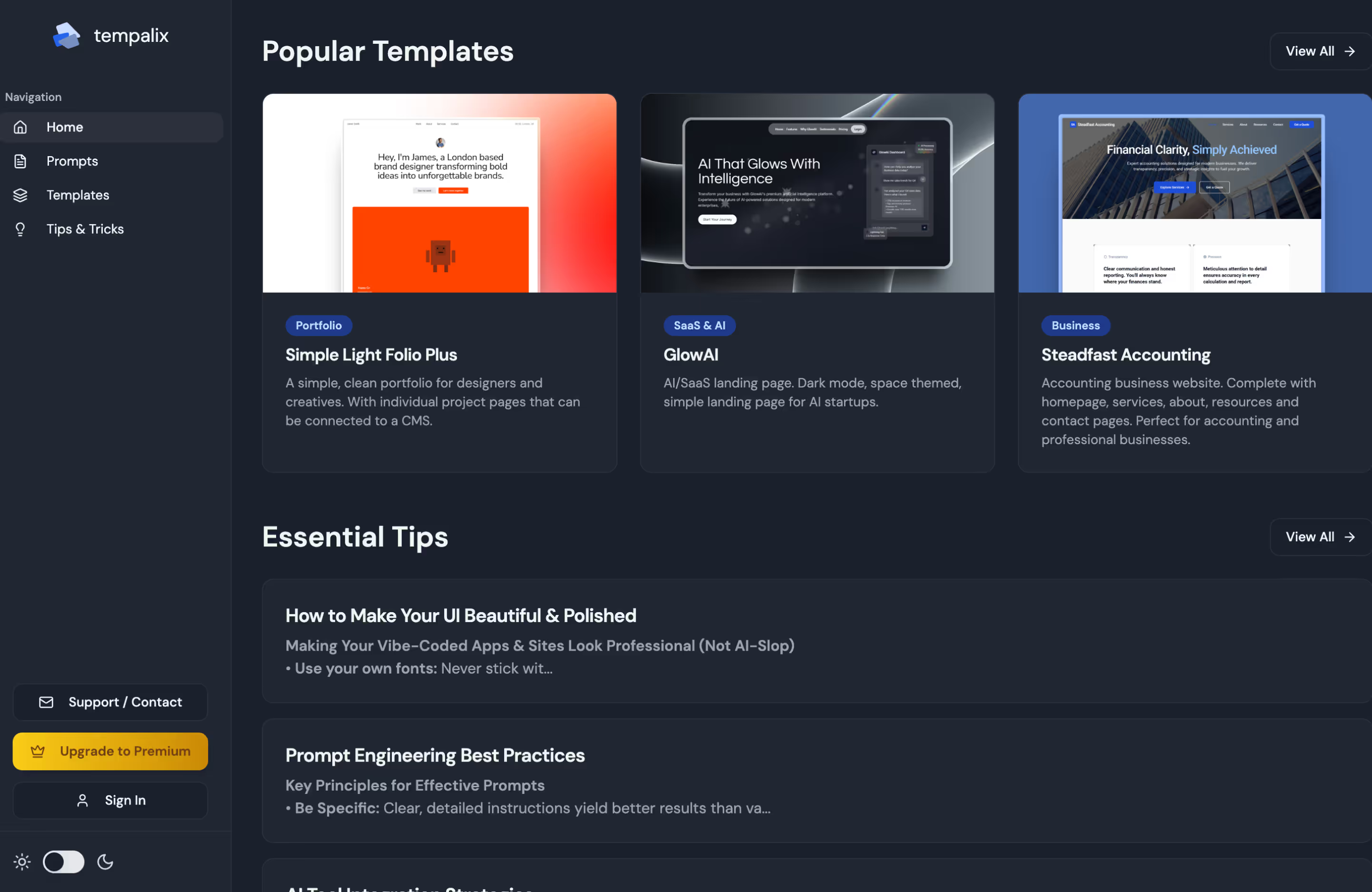
If your app is playful and creative, your consent language and design should be too. If it's a professional productivity tool, the tone should be clear, efficient, and reassuring. By aligning the consent experience with your overall brand, you reinforce that privacy and user respect are core to your product's DNA, not an afterthought. This is the essence of why Vibe Coding Inspiration's mission is clear: to provide a centralized hub for discovering and sharing vibe-coded products that feel cohesive and user-centric.
5. Continuous Conversation: Mastering Dynamic Consent
This is the most advanced—and most crucial—principle for AI products. Dynamic consent acknowledges that a user's preferences and your AI's data needs can change. The goal is to manage these changes without causing "consent fatigue."
- Time-Limited Consent: For ongoing processes, consider asking for permission for a set period (e.g., 90 days). This gives the user a chance to re-evaluate the relationship and builds trust by showing you're not asking for a blank check forever.
- Graceful Update Prompts: When your AI needs new permissions, explain why in a clear, benefit-driven notification. Instead of a generic "Our privacy policy has changed," try: "Our AI can now help you draft emails. Want to grant access to your contacts to try it out?"
Seeing it in Action: Real-World Examples & Anti-Patterns
Theory is great, but seeing it in practice makes all the difference. To truly discover, remix, and draw inspiration from various projects built using vibe coding techniques, it's helpful to see what to do—and what to avoid.
The Do's: Examples of Great Consent UX
- The Layered Approach: A health app shows a simple screen: "To personalize your fitness plan, our AI analyzes your activity and sleep data." Below are two links: "Learn More" (a detailed breakdown) and "Got it!"
- The Granular Toggle: A music app has a "Personalization" screen with toggles for "Use listening history for daily mixes," "Analyze location for concert recommendations," and "Share data with marketing partners."
- The Just-in-Time Prompt: An AI writing assistant, upon first use of a new "summarize this document" feature, prompts: "To summarize this, I need to send its content to our secure AI partner. Is that okay?"
The Don'ts: Common "Dark Patterns" to Avoid
Dark patterns are deceptive UX choices that trick users into doing things they didn't intend to, like sharing more data than they're comfortable with.
- Pre-checked Boxes: Consent must be an active choice. Opt-in should always be the default.
- Vague Language (The "Cookie Wall"): Using confusing or broad terms like "for functional purposes" or "to improve your experience" without specifics.
- The Roach Motel: Making it incredibly easy to opt-in but nearly impossible to find the settings to opt-out later.
Your Vibe-Coded Consent Checklist
Ready to build a consent flow that builds trust? Use this checklist to audit your existing process or design a new one from scratch.
- Clarity: Is our language simple, direct, and free of jargon?
- Scannability: Do we use formatting (headings, lists) to make information easy to digest?
- Granularity: Can users choose which types of data they share, or is it all-or-nothing?
- Interactivity: Are we using UI elements like toggles or sliders to make consent an active choice?
- Context: Are we asking for permissions at the moment they are needed?
- Brand Alignment: Does the look, feel, and tone of our consent screen match our product's vibe?
- Transparency: Is it easy for users to find and change their consent settings later?
- Evolution: Do we have a plan for how to handle requests for new permissions as our AI evolves?
Frequently Asked Questions (FAQ)
What is a consent flow?
A consent flow is the complete user journey for giving permission for data processing. It includes the initial pop-ups, information screens, interactive choices (like checkboxes or toggles), and the confirmation of consent.
What is user consent in AI?
In AI, user consent is explicit permission from a user for an AI system to collect, use, and learn from their data. It's more complex than in traditional software because the way an AI uses data can change over time as it learns.
What is a good example of user consent?
A great example is a navigation app that asks for location access only when you search for directions. It explains why it needs the access ("to give you turn-by-turn directions") and offers choices ("Only While Using the App," "Just This Once," or "Don't Allow").
From Consent to Connection
Designing a consent flow is no longer a task to be offloaded to the legal department. It's a core design challenge that sits at the intersection of user experience, ethics, and brand identity.
By embracing the principles of Vibe-Coded Consent, you shift the narrative from a mandatory obligation to a meaningful opportunity. You begin your user relationship with a foundation of clarity, choice, and trust. You prove that you respect your users not just as data points, but as partners in building a smarter, more personalized experience. And in the rapidly evolving world of AI, that trust is the most valuable asset you can have.
Explore the possibilities and see how different developers are tackling these challenges by checking out the wide range of projects developed with tools like Bolt, Cursor, Google AI Studio, and Loveable.