.svg)
Your AI Works Flawlessly, But Why Do Users Leave? The Vibe Audit Framework
You’ve done it. After countless hours of coding, tweaking prompts, and debugging, your AI application is finally live. The features work, the logic is sound, and the output is accurate. Technically, it’s a success.
But you keep seeing the same pattern: users sign up, try it once or twice, and never come back. Your dashboard shows a steady stream of new sign-ups but a dismal retention rate. The app functions perfectly, yet it feels like there’s an invisible wall between it and your users.
What’s missing? It’s not a feature or a bug fix. It’s the ‘vibe.’
That intangible, hard-to-pin-down quality that makes a user feel connected to a product. It’s the difference between an app that’s merely a tool and one that becomes a trusted creative partner. And in a world where AI is becoming more personal and conversational, the vibe isn’t just a nice-to-have; it’s a critical component for success. The problem is, how do you measure a feeling?
This is where the Vibe Audit Framework comes in. It’s a structured approach to transform the subjective "feel" of your product into objective, actionable insights.
What Exactly is a 'Vibe' in a Digital Product?
Think of 'vibe' as your application's personality. It’s the sum of every micro-interaction, every word choice, every color, and every response time. It's not just about user experience (UX), which focuses on usability and efficiency. Vibe is about the emotional resonance—the overall feeling your product evokes.
- Slack feels collaborative and a bit playful.
- Notion feels organized, clean, and powerful.
- Duolingo feels encouraging, fun, and slightly addictive.
These feelings aren't accidental. They are the result of deliberate design choices that go beyond functionality. And this emotional connection is what drives loyalty and growth. Research consistently shows that emotionally connected customers have a 306% higher lifetime value. They stick around longer, forgive the occasional bug, and become your most vocal advocates. When you ignore your product’s vibe, you’re leaving your most powerful growth lever on the table.
The Challenge: You Can't Improve What You Can't Measure
For most developers and creators, "vibe" feels frustratingly abstract. You know when it's wrong, but you can't articulate why. Your feedback sessions are filled with vague comments like "it just feels a bit… cold" or "I don't know, it's not very inspiring."
This is the classic innovator's dilemma. We’re taught to focus on what’s quantifiable: load times, conversion rates, and feature adoption. But the reality is that up to 95% of purchasing decisions are subconscious and driven by emotion. If your AI product’s vibe triggers the wrong subconscious feelings—like confusion, intimidation, or boredom—users will churn without ever being able to tell you exactly why.
The Vibe Audit Framework provides the structure to dissect these feelings, measure them, and start designing for emotion with intention.
The Vibe Audit Framework: 4 Steps to Quantify Feeling
This framework breaks down the audit process into manageable steps, blending qualitative feedback with quantitative data to give you a complete picture of your product's emotional impact.
Step 1: Define Your Target Vibe
Before you can measure your current vibe, you need to know what you’re aiming for. What emotion should your product evoke? This should be deeply connected to its core purpose.
- An AI writing assistant like the [] project might aim for a vibe that is "Inspiring, Supportive, and Clever."
- A mood-tracking tool might aim for "Calm, Reassuring, and Non-judgmental."
- A creative tool for animating photos like [] could aim for "Magical, Nostalgic, and Playful."
Your Action: Choose 3-5 core "Vibe Adjectives" that represent the ideal emotional state you want users to experience. Write them down. These will be your north star for the entire audit.
Step 2: Assemble Your Audit Toolkit
A good audit uses a mix of tools to capture both the "what" (quantitative) and the "why" (qualitative).
- Qualitative Tools (The 'Why'):
- User Interviews: Sit down with 5-10 users and ask open-ended questions. "Walk me through how you felt during onboarding." "How would you describe this app's personality to a friend?"
- 5-Second Tests: Show new users your app's main screen for just five seconds. Then, hide it and ask them: "What words come to mind?" "What did you feel?" Compare their answers to your Vibe Adjectives.
- App Store & Social Media Sentiment Analysis: Read your reviews and mentions. Ignore the feature requests for a moment and look for emotional language. Are users "frustrated," "delighted," "confused," or "impressed"?
- Quantitative Tools (The 'What'):
- In-App Surveys: Use simple pop-up surveys with Likert scales (e.g., "On a scale of 1-5, how 'Inspiring' did you find this feature?").
- A/B Testing: Test different copy, color palettes, or AI response tones. Does a more formal tone increase task completion but decrease session time?
- Behavioral Analytics: Look at metrics like session duration, feature adoption, and drop-off rates at specific points. A high drop-off rate after an AI interaction could signal a vibe mismatch.
Step 3: Audit Across Key Touchpoints
A product's vibe is built across the entire user journey. Analyze each stage through the lens of your Vibe Adjectives.
- Onboarding: Does the first-run experience feel welcoming and exciting, or is it an overwhelming chore? Is the language supportive or robotic?
- Core AI Interaction: This is the heart of your product. If your target vibe is "Playful," but your AI's responses are dry and literal, you have a major disconnect. Analyze the tone, speed, and personality of your AI.
- Error States & Empty States: What happens when something goes wrong or when there’s no data to show? A well-designed error message can turn a moment of frustration into a positive brand interaction. Does your app say "Error: 404" or "Oops! It seems this page is playing hide-and-seek. Let's get you back on track."?
- Micro-interactions & Visuals: Do your button animations, color choices, fonts, and loading screens support your target vibe? A financial app aiming for a "Trustworthy" vibe shouldn't use playful, bouncing animations.
Step 4: Calculate and Track Your Vibe Metrics
Now, let's turn your findings into concrete metrics you can track over time. This is how you prove the value of your work and monitor progress.
[]
- Vibe Adjective Score (VAS): For each of your target adjectives, calculate the average score from your user surveys (e.g., "Inspiring" scores a 3.2/5). This is your baseline. Your goal is to increase this score with every design change.
- Sentiment Ratio: Tally the positive vs. negative emotional keywords from your review analysis. Aim to improve this ratio over time.
- Emotional Resonance Score (ERS): Create a custom blended metric to connect vibe to business goals. A simple formula could be: (Average VAS) x (30-Day User Retention %) = ERS. This directly links how users feel to whether they stay.
By tracking these metrics, you move from "I think the vibe is off" to "Our 'Supportive' score dropped by 15% after the last update; let's investigate the changes we made to the AI's instructional copy."
Frequently Asked Questions
What's the difference between UX and Vibe?
Think of it this way: UX is the skeleton and muscles—it’s about whether the body can function correctly and efficiently. Vibe is the personality and style—it’s what makes someone interesting and enjoyable to be around. An app can have perfect UX (it's easy to use) but a terrible vibe (it feels boring or condescending). You need both to create something people love.
How often should I conduct a Vibe Audit?
A full audit is valuable before a major redesign, after a significant feature launch, or if you notice a sudden drop in engagement. A "mini-audit" focusing on one key touchpoint or one Vibe Adjective can be done quarterly to keep your product's emotional pulse in check.
Is this just for consumer apps?
Absolutely not. Every product has a vibe. Enterprise tools are a great example. Compare the corporate and formal vibe of Microsoft Teams to the slightly more casual and channel-focused vibe of Slack. That difference in feeling is a major factor in which tool a team prefers to use all day.
Can a Vibe Audit fix a fundamentally flawed product?
No. A great vibe can't save a product that doesn't solve a real problem or is riddled with critical bugs. Functionality comes first. But a Vibe Audit can diagnose why a functionally good product isn't connecting with its audience, which is a far more common and mysterious problem to solve.
From Functional to Phenomenal
Stop guessing why your users aren't sticking around. The 'vibe' of your AI application is no longer an intangible mystery—it's a designable, measurable, and critical component of your product's success. By implementing the Vibe Audit Framework, you can start listening to your product's emotional heartbeat and making intentional choices that forge a genuine connection with your users.
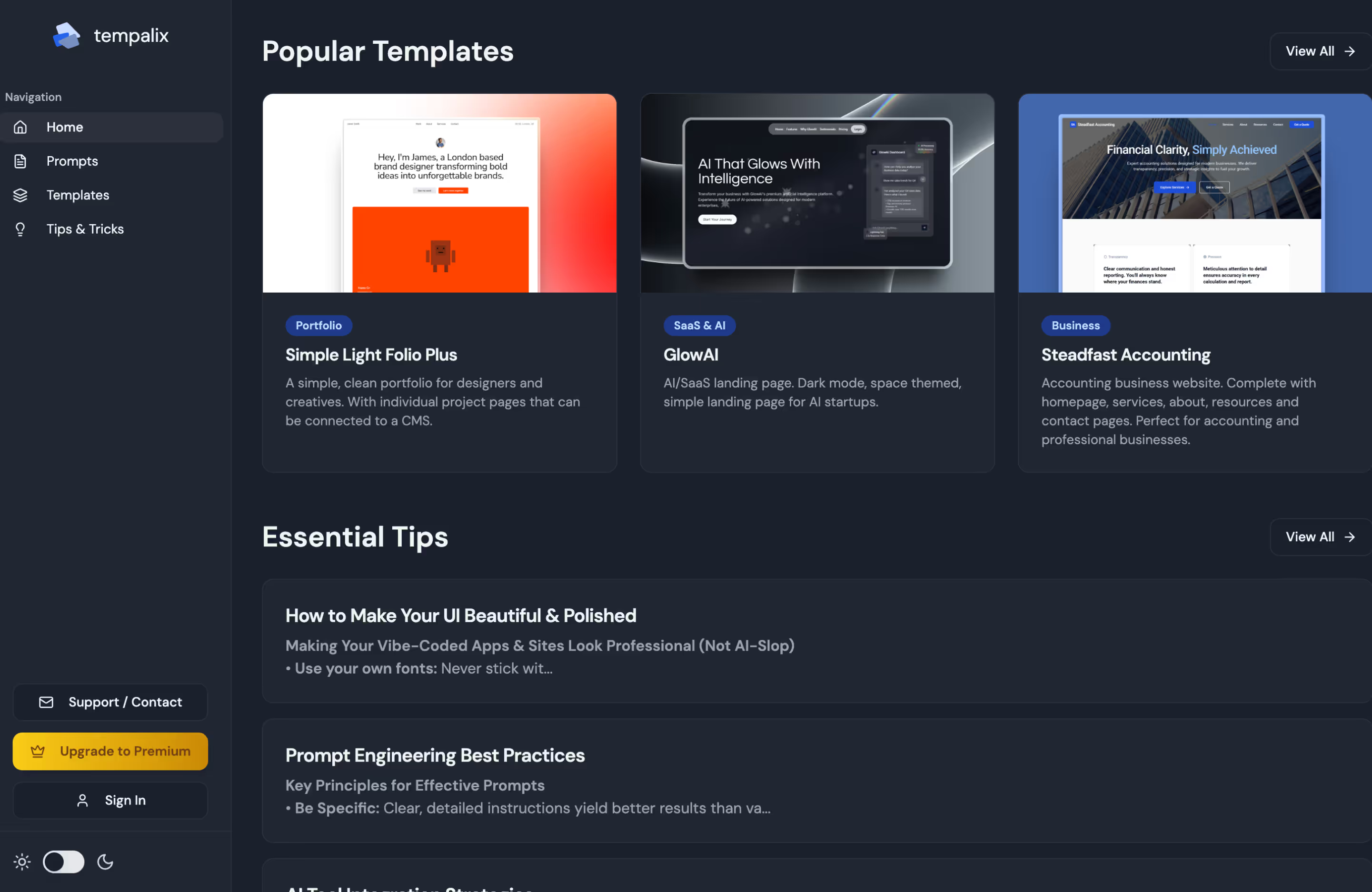
Ready to see what a product with a phenomenal vibe looks like? Explore the curated gallery on [] to discover and get inspired by AI-assisted applications that absolutely nail their emotional connection.