.svg)
Breaking the 'AI for AI's Sake' Cycle: A Guide to Vibe-First AI Brainstorming
You've seen it. That new AI feature in your favorite app that feels… off. It’s technically impressive but solves a problem you never had. It complicates a simple workflow or offers suggestions that miss the point entirely. It feels like a solution in search of a problem.
This is the hallmark of the "AI for AI's sake" cycle—a frantic rush to bolt AI onto products without asking the most important question first: Why?
We’re so caught up in the how of AI implementation that we’ve forgotten the why. The result is a landscape of gimmicky, soulless features that add clutter, not value. But what if there was a better way? A method to ensure every AI feature you brainstorm not only solves a real problem but deepens the user's connection to your product's core identity?
That method is Vibe-First AI Ideation. And it starts by defining your product’s soul.
The Epidemic of Soulless AI
The current educational landscape is filled with excellent resources. Giants like the Nielsen Norman Group provide cautious, invaluable advice on using AI as a "sidekick" for existing UX tasks. Others, like Eleken, brilliantly map AI capabilities to the design thinking process to improve adoption.
But there’s a massive gap. Most guides jump from "what is AI?" to "how do I build it?" They skip the most critical step: "What should we build, and why should it exist?"
This oversight is why so many AI features fail. A conclusion from Eleken's research on AI adoption is that features fail when UX is an afterthought. We'd take it a step further: AI features fail when the core user purpose is an afterthought.
When teams brainstorm from a technology-first perspective, they ask questions like:
- "What can we do with this new Large Language Model?"
- "How can we add a chatbot to our homepage?"
- "Can we use generative AI to make cool images?"
These questions lead to features that feel bolted on. They don't resonate because they weren't born from a place of genuine user need or product identity.
The Antidote: Defining Your Product's "Vibe"
Before you ever write a single line of AI-related code, you need to articulate your product's core vibe.
Think of the "vibe" as your product's emotional fingerprint. It's the intangible feeling users get when they interact with your creation. It’s the promise you make to them, not in features, but in feeling.
Is your product's vibe:
- Calm and Focused? (Like a minimalist writing app)
- Playful and Creative? (Like a collaborative design tool)
- Efficient and Professional? (Like a project management system)
- Comforting and Secure? (Like a personal finance app)
This "vibe" is your constitution. It's the ultimate filter for every decision you make, especially when brainstorming something as powerful and potentially intrusive as AI. If an AI feature idea violates your product's core vibe, it doesn't matter how technologically advanced it is—it's the wrong feature.
The Vibe-First AI Ideation Framework
Instead of starting with technology, start with purpose. This framework flips the script, ensuring your brainstorming sessions produce meaningful, vibe-aligned AI features that users will actually love.
Phase 1: Problem-Space Expansion (AI as the Research Assistant)
Here, we use AI not to find solutions, but to find problems. The goal is to get a deeper, more nuanced understanding of your users' challenges. As the Nielsen Norman Group advocates, AI is safest and most effective when used by experienced professionals to augment their skills, and this is a perfect low-risk, high-reward application.
How to do it:
- Feed the Machine: Gather raw user data—support tickets, reviews, forum posts, interview transcripts.
- Prompt for Patterns: Use a large language model to analyze this data. Ask questions like:
- "Summarize the top 5 frustrations mentioned in these support tickets."
- "Identify recurring themes related to 'wasted time' in these reviews."
- "What are the underlying emotional states described in these user interviews? (e.g., anxiety, confusion, excitement)"
- Human Curation: The AI's output is not the answer; it's a starting point. Your team's job is to interpret these patterns and identify the most pressing, vibe-aligned problems to solve.
Phase 2: Vibe-Driven Brainstorming (The Human-Led Workshop)
Now that you have a rich understanding of the problem space, it's time for the human-led ideation. This is where your team's creativity, empathy, and knowledge of the product's vibe come into play.
How to run the workshop:
- Set the Stage: Begin by reviewing your product's defined core vibe and the key user problems identified in Phase 1. This is your North Star.
- Ask Better Questions: Instead of "What AI can we add?", frame your brainstorming prompts around the user and the vibe.
- Instead of: "How can we use generative AI?"
- Ask: "How might we help our users feel more creative and less stuck?"
- Instead of: "Should we add an AI chatbot?"
- Ask: "What's the most seamless, non-intrusive way to provide instant help when a user feels confused?"
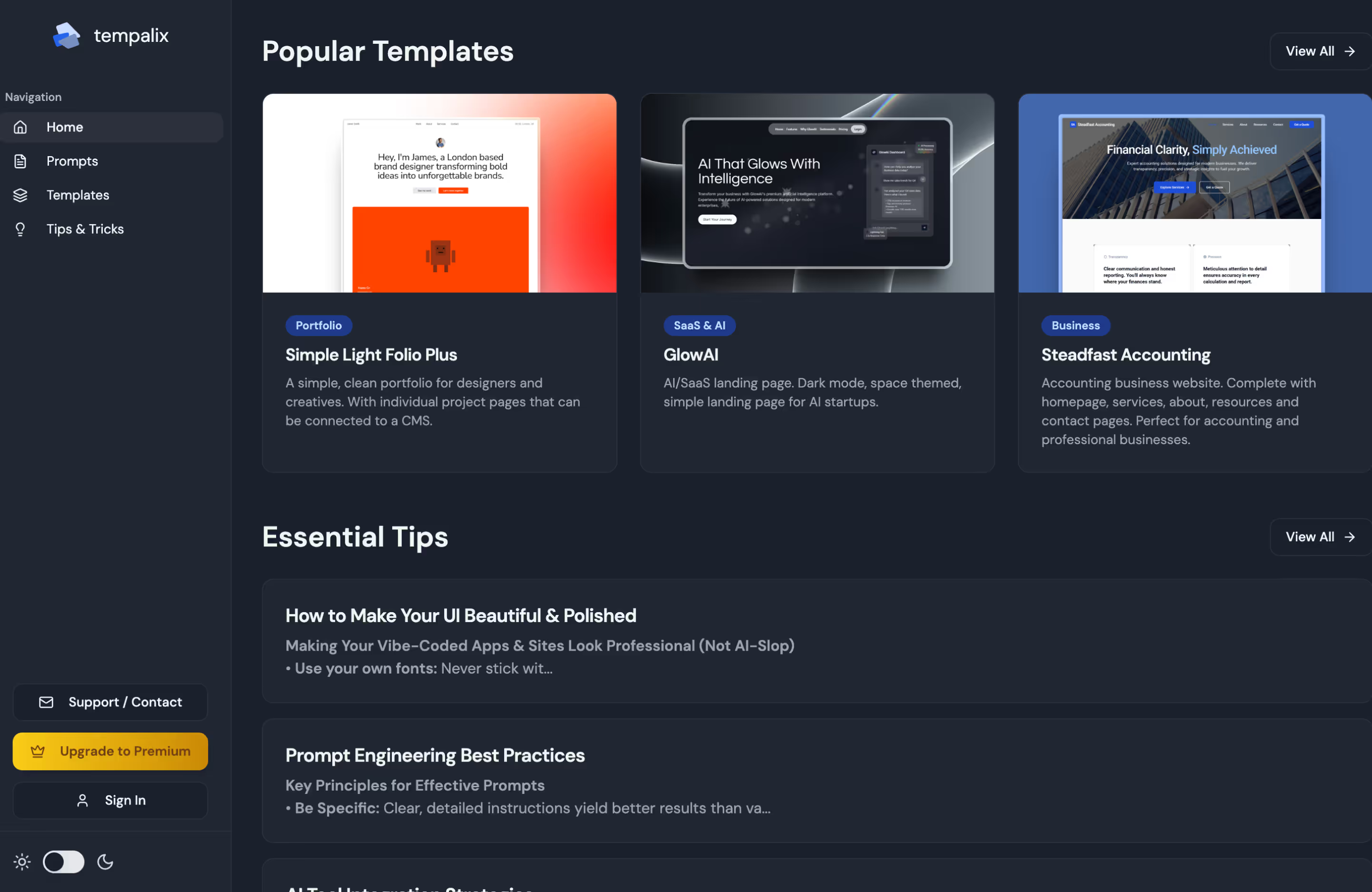
- Ideate Wildly: Encourage all ideas, but gently guide the conversation back to the core vibe and user problem if it veers into tech-for-tech's-sake territory. This is where you can explore some of the
that have successfully nailed their vibe.
Phase 3: The "Vibe-Check" Gauntlet (Filtering Your Ideas)
You'll leave the workshop with a wall full of ideas. Most of them won't make the cut. The Vibe-Check Gauntlet is a rigorous checklist to separate the truly valuable ideas from the gimmicks.
For each promising idea, ask your team these questions. Be brutally honest.
The Vibe-Check Gauntlet:
- The Vibe Test: Does this feature enhance or dilute our product's core vibe? (e.g., Does this hyper-efficient AI assistant feel out of place in our playful, creative app?)
- The "Magic Wand" Test: Does this feel like magic, or does it feel like work? Does it remove friction or add a new layer of complexity?
- The Problem-Solution Test: Does this solve a real, documented user problem from our research, or are we inventing a problem for our cool solution?
- The Empowerment Test: Does this empower the user and give them more control, or does it make decisions for them in a way that feels opaque and restrictive?
- The "Without AI" Test: Could we solve this problem 80% as well with a simpler, non-AI solution? (If yes, you should probably do that instead).
Only the ideas that survive this gauntlet are worthy of being prototyped and tested. They are the ones that have been vetted not just for technical feasibility, but for human resonance.
From Ideation to Interaction
Once an idea passes the vibe-check, the journey isn't over. The principles of good design are more critical than ever. As you move toward building, focus on creating transparent, trustworthy, and controllable AI interfaces. Users need to understand what the AI is doing, why it's doing it, and how they can correct it when it's wrong. For those ready to start building, exploring can provide a practical path forward.
By grounding your AI strategy in your product's core vibe, you break the cycle of building tech for tech's sake. You start creating AI that feels less like an invasive robot and more like a thoughtful partner—one that understands not just what users do, but how they want to feel.
Frequently Asked Questions (FAQ)
What is an AI-driven user experience?An AI-driven user experience (UX) is one where artificial intelligence is used to enhance or personalize a user's interaction with a product. This can range from simple product recommendations (like on Netflix) to complex generative tools that create content based on user prompts. A good AI-driven UX feels seamless, helpful, and almost invisible.
How can AI improve user experience?When used purposefully, AI can dramatically improve UX by:
- Personalizing Content: Tailoring experiences to individual user preferences and behaviors.
- Reducing Friction: Automating tedious tasks like data entry or summarizing long documents.
- Providing Proactive Assistance: Offering help or suggestions before the user even realizes they need it.
- Unlocking Creativity: Providing tools that act as a creative partner for writing, design, or music.
What are common challenges that block AI adoption?Users often resist AI features due to a lack of trust, a fear of losing control, privacy concerns, or simply because the feature is confusing and doesn't solve a real problem. This is why a vibe-first, human-centered approach is so critical—it builds trust and ensures the AI is genuinely useful.
Where do I start with AI feature brainstorming?Start with your users and your product's core purpose, not with the technology. Use the Vibe-First AI Ideation Framework: Define your vibe, use AI to find user problems in your existing data, and then run a human-centered brainstorming session to solve those problems in a way that honors your product's soul.